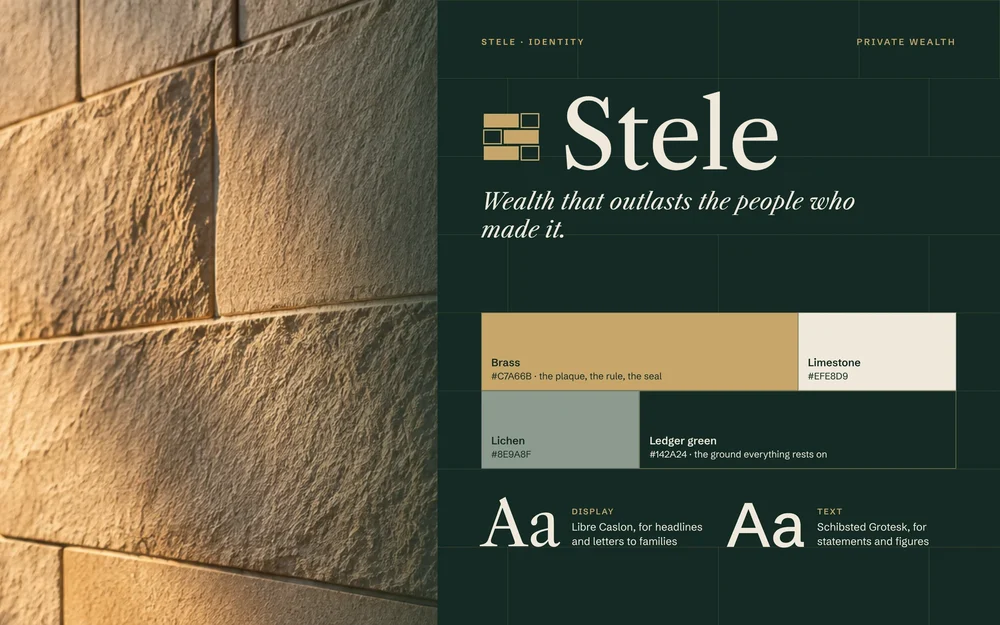
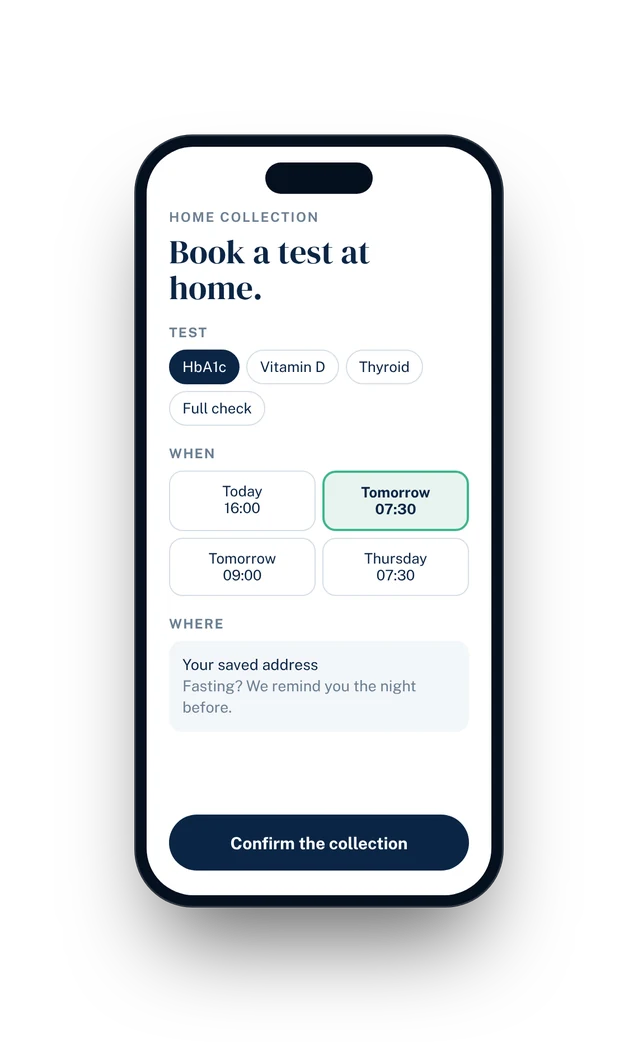
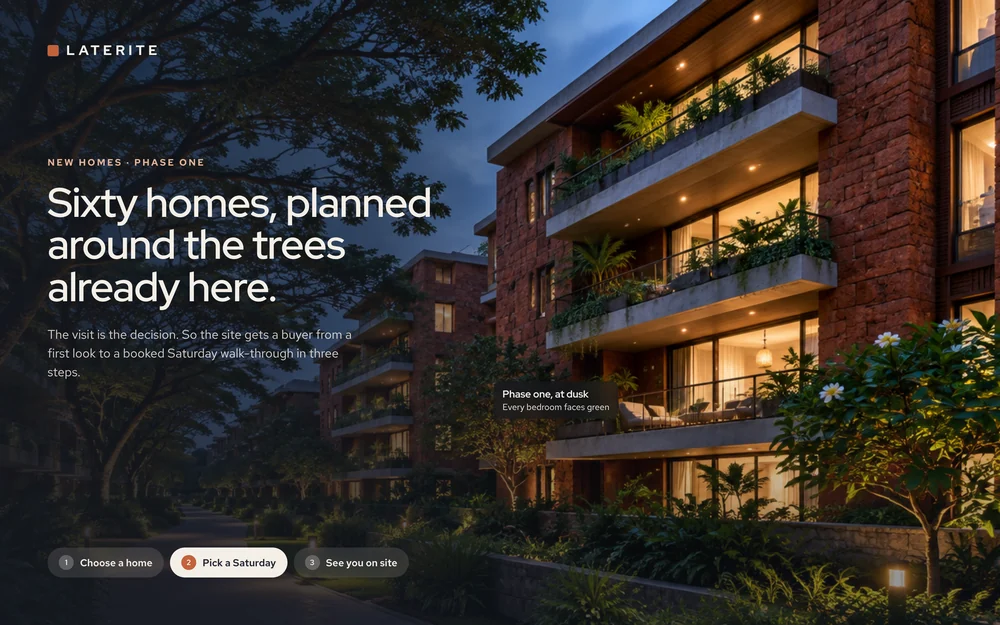
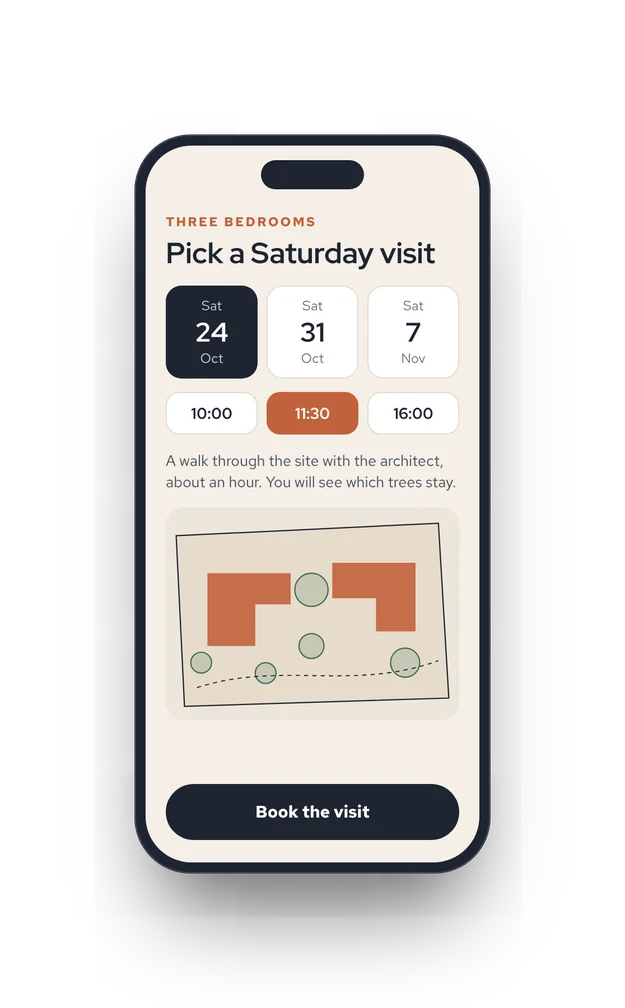
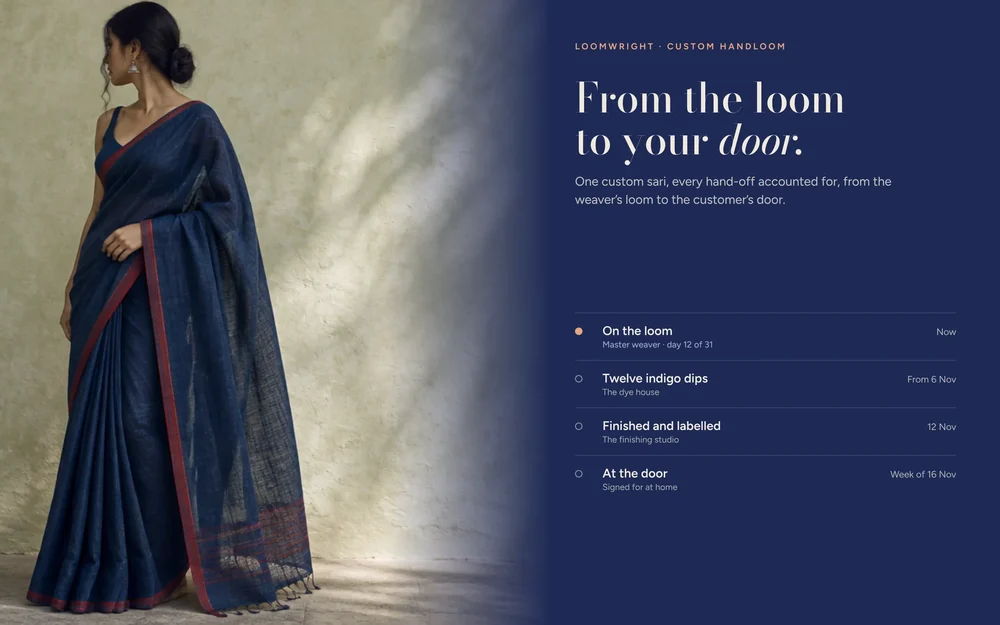
01 / 04RecognisedStele, a Dexivio study. Identity for a private wealth firm.ReachedClearwell, a Dexivio study. Home tests and results people can read.ExperiencedLaterite, a Dexivio study. The visit journey for new homes.RunLoomwright, a Dexivio study. The order desk for a handloom label.RecognisedStele, a Dexivio study. Identity for a private wealth firm.
A story within a story.
Your business has a story. So does every visitor, who arrives with a question or a need of their own. We design websites that answer both, so people see what makes you different and can take the next step without hunting for it.
01 / 06Dexivio studies
01
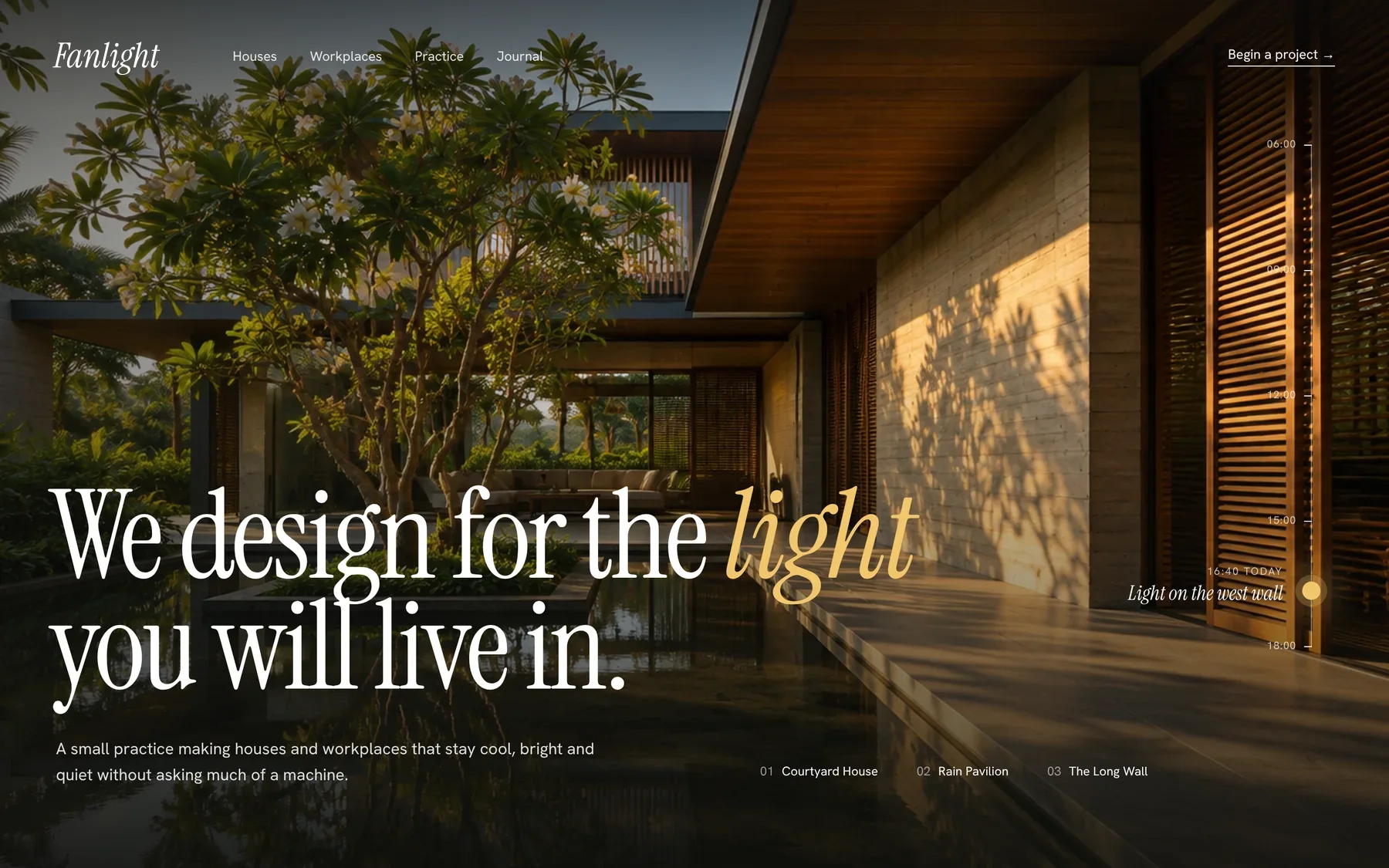
FanlightArchitecture practice
A daylight scale follows the sun across the house, because the practice designs around light.
Who it serves
Families and businesses commissioning a building.
What the visitor needs
To feel what living or working in the practice’s spaces is like.
The design move
The scale marks the time of day and where the light is falling on the house, so visitors see how the practice works from the first screen.
The next step
Begin a project, with past work one tap away.
Instrument Serif and Hanken Grotesk · quiet and photographic
02
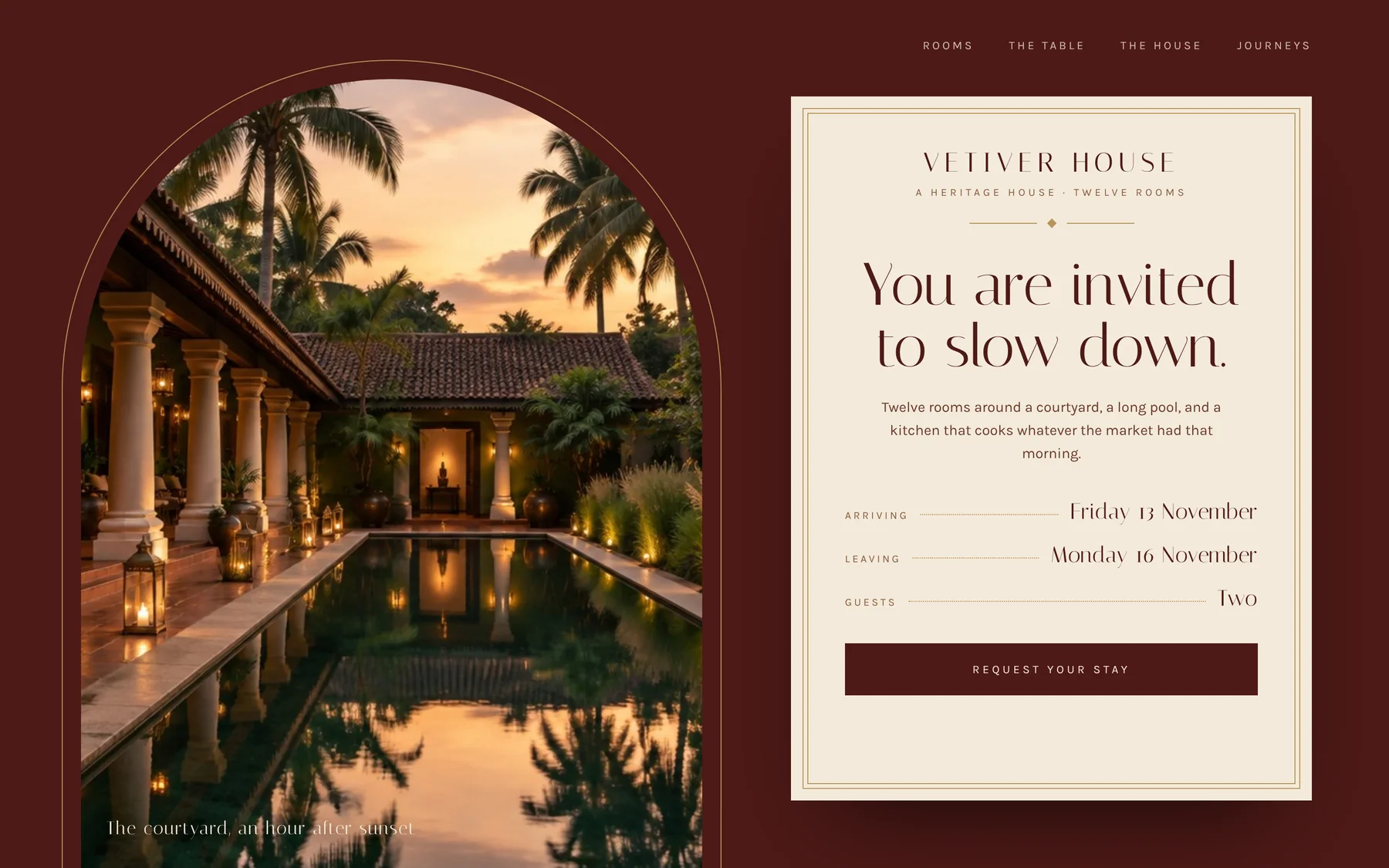
Vetiver HouseHeritage hotel
Booking reads like an invitation you reply to.
Who it serves
Guests planning a slow weekend or a family occasion.
What the visitor needs
To picture the stay and check dates without effort.
The design move
The page invites the guest first, then asks for dates and guests as a reply.
The next step
Dates and guests on the first screen, then a request to stay.
Italiana and Karla · formal and romantic
03
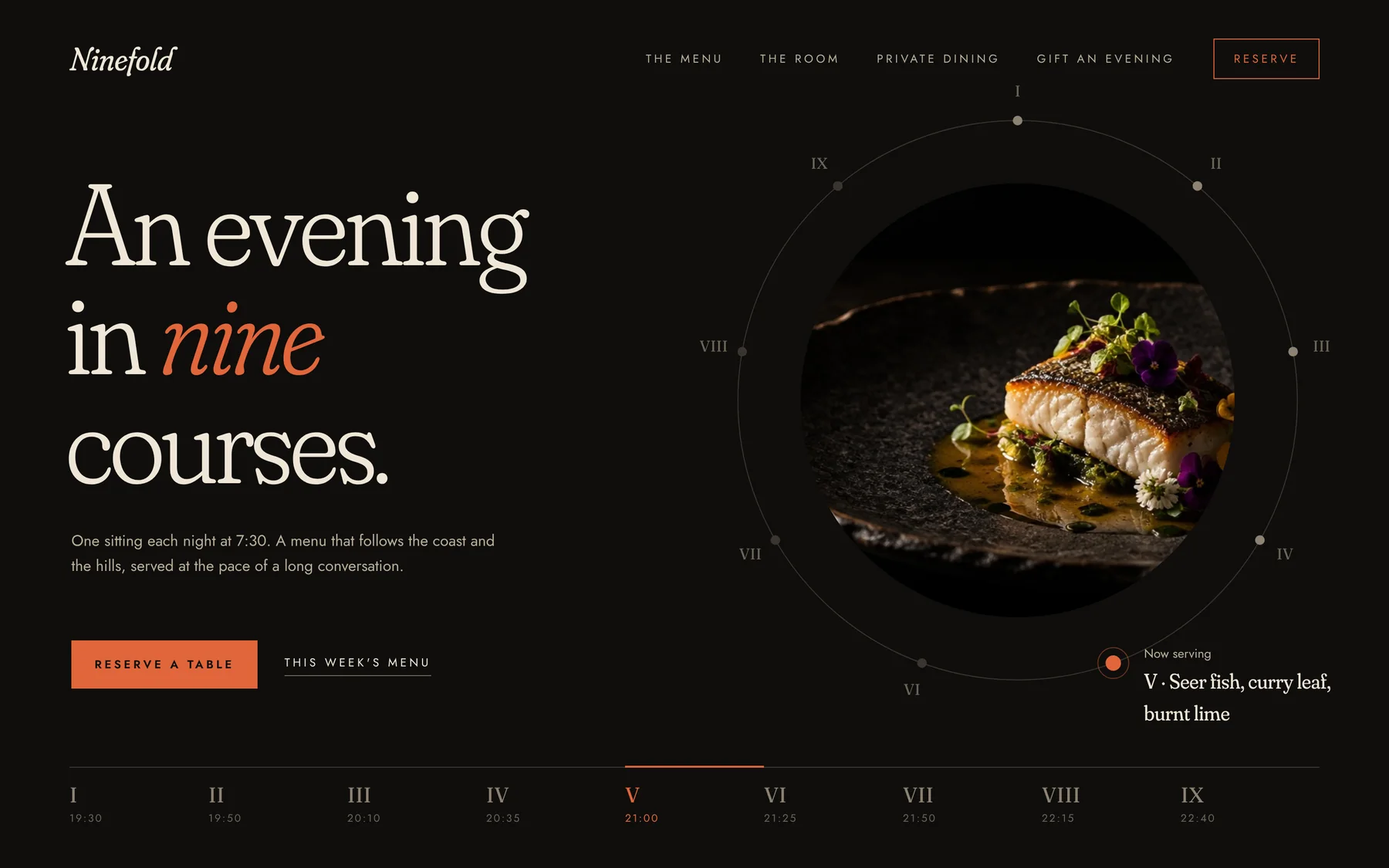
NinefoldTasting-menu restaurant
The evening is drawn as a clock of nine courses, so guests feel the pace before they book.
Who it serves
Diners planning a special evening.
What the visitor needs
To understand the format before committing to a long dinner.
The design move
Each of the nine courses has its time on a strip along the foot of the page, and the course being served is marked.
The next step
Reserve a table, or read this week’s menu first.
Fraunces and Jost · dark, warm, unhurried
04
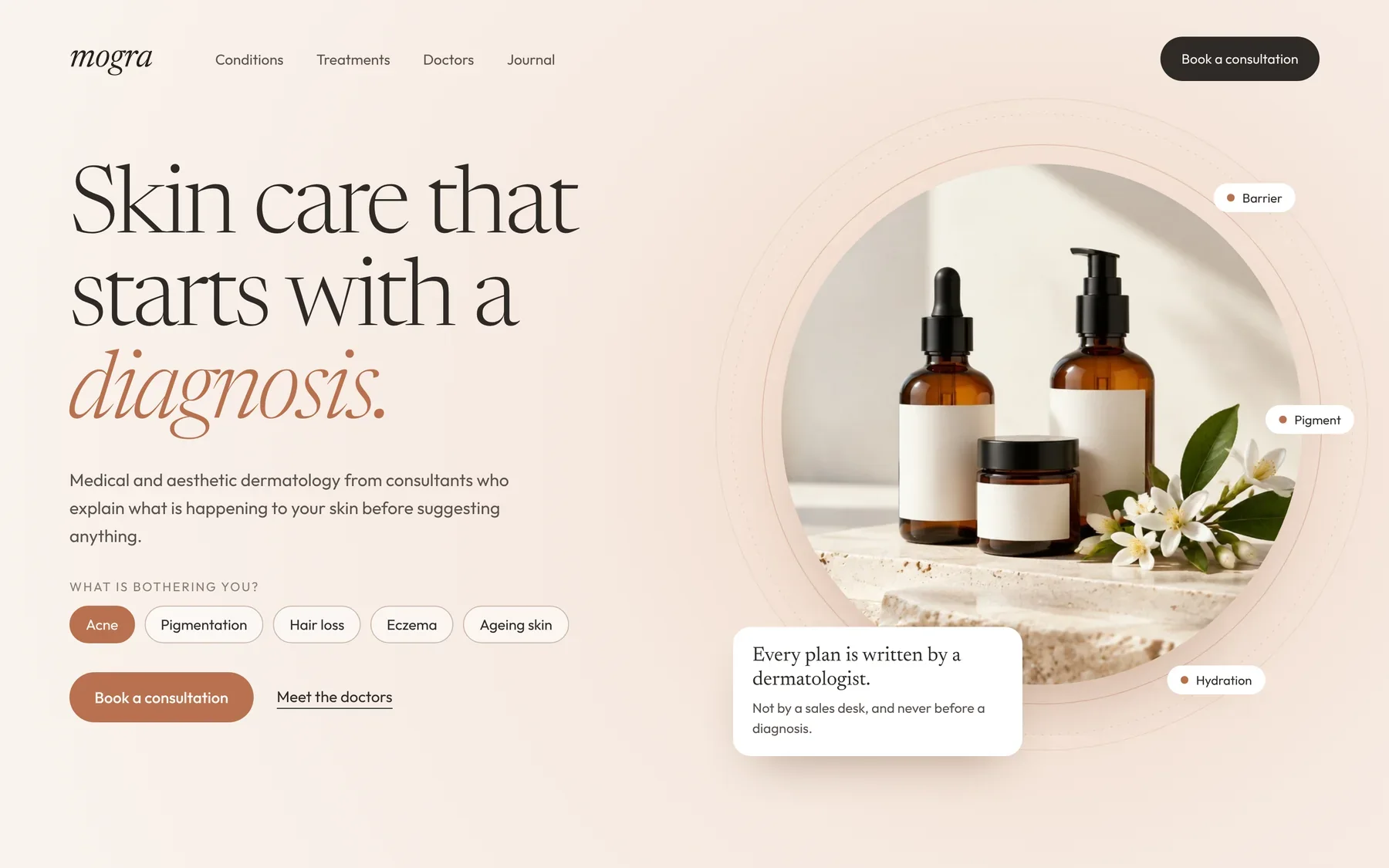
MograDermatology clinic
Products appear inside a round lens, and the first question asks what is bothering you.
Who it serves
Patients with a skin concern.
What the visitor needs
Reassurance that a doctor will look at the problem before anything is sold.
The design move
The page leads with diagnosis, and a patient starts by picking their concern, such as acne or eczema.
The next step
Pick a concern and book a consultation.
Newsreader and Outfit · soft and clinical
05
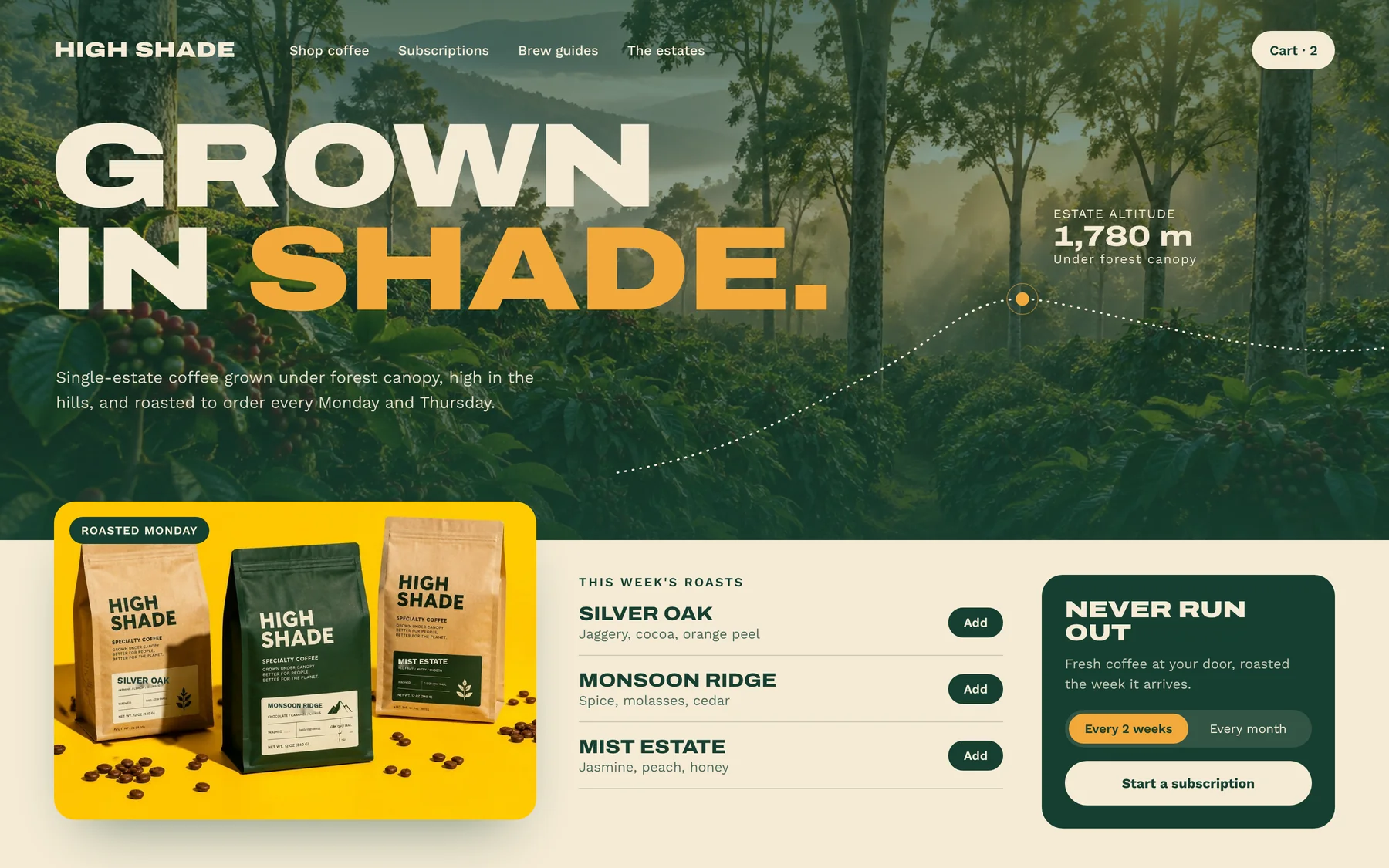
High ShadeCoffee roaster
The estate’s hills run across the page, so each coffee is shown where it was grown.
Who it serves
People who buy coffee online to brew at home.
What the visitor needs
To know where the coffee comes from and when it was roasted.
The design move
The first screen gives the estate’s altitude and the roast days, Monday and Thursday.
The next step
Add this week’s roast, or start a subscription.
Archivo Expanded and Work Sans · bold and outdoorsy
06
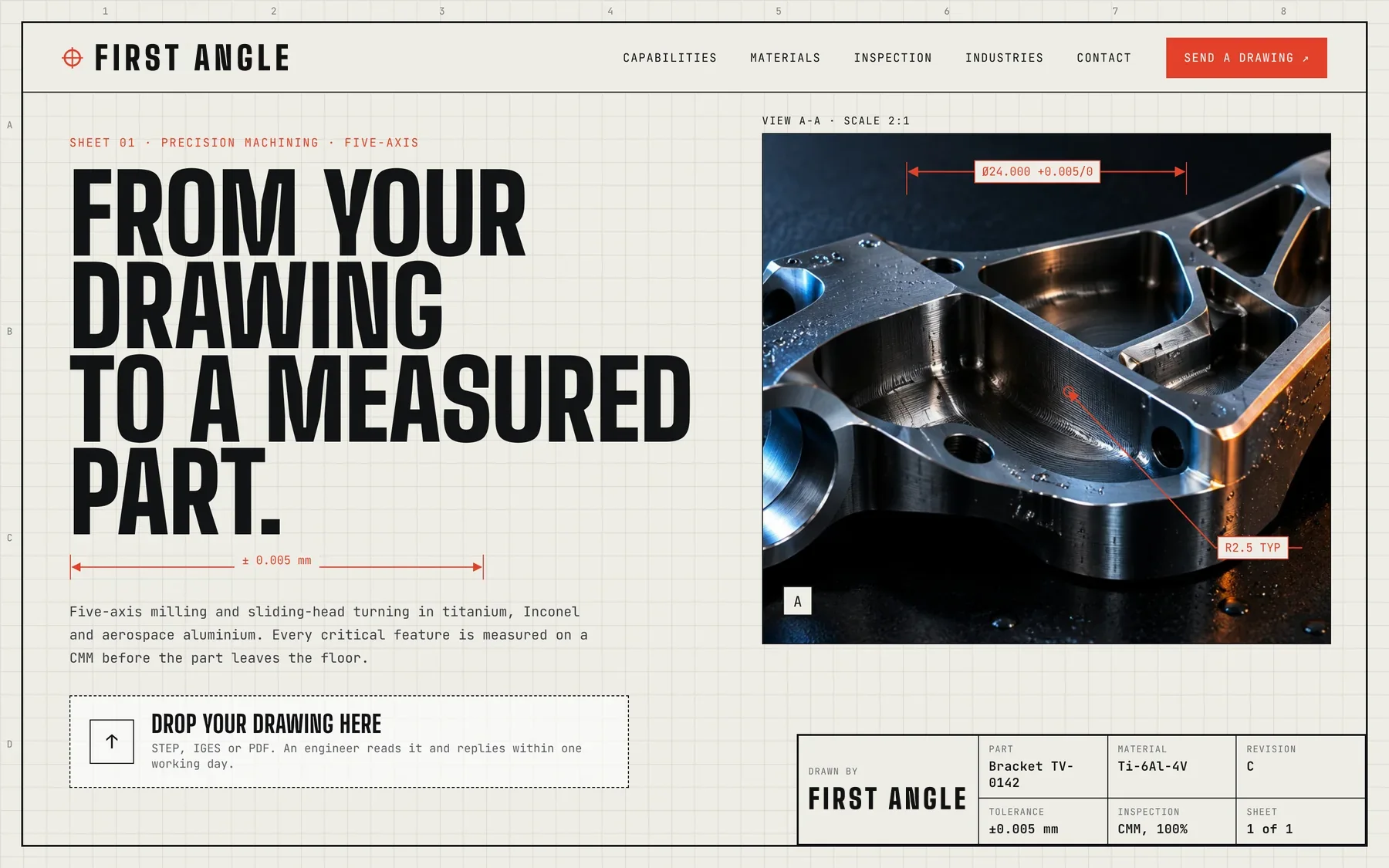
First AnglePrecision engineering
The page reads like an engineering drawing, and the first thing it asks for is yours.
Who it serves
Procurement and engineering teams buying machined parts.
What the visitor needs
To know quickly whether this shop can make their part, to tolerance and on time.
The design move
Tolerance, material and inspection are set out in a drawing’s title block, the format buyers already work with.
The next step
Drop a drawing on the first screen, and an engineer replies.
Big Shoulders Display and JetBrains Mono · an exact drafting sheet
How one enquiry is designed to move from a search to the owner, shown through Vetiver House, a Dexivio study of a heritage hotel.
Someone asks a question. Your business answers it clearly.Search, answer engines and local listings
The phone shows what the guest sees at each step.
9:41● ● ●
quiet heritage stay with a courtyard and pool
AllMapsHotelsImages
Vetiver House
Heritage hotel · courtyard rooms · pool
WebsiteDirectionsCall
From Vetiver House · the stayA heritage house with twelve rooms around a courtyard and a long pool, for slow weekends and family occasions.
9:42● ● ●
Vetiver House
Choose your room
Courtyard Room Opens onto the pool
Garden Room Quieter, under the neem tree
DatesFri 13 Nov → Mon 16 Nov
Guests2
Continue
9:43● ● ●
Vetiver House · your stay
Tell us about the occasion
Courtyard Room · Fri 13 – Mon 16 Nov · 2 guests
Is this for an occasion?
AnniversaryBirthdayA family visitA weekend away
Anything we should know?
Ground floor if possible
Request to stay
9:44● ● ●
Request received
Thank you. The house has your request.
You will hear back by email with availability and the next step.
Courtyard RoomFri 13 – Mon 16 Nov2 guestsAnniversaryGround floor if possible
The owner’s view fills in at the last step
Owner’s viewWaitingNew stay requestjust now
Everything the guest told us, in one request to act on.
Dates
Fri 13 – Mon 16 Nov3 nights
Guests
2 guests
Room
Courtyard Room
Occasion
Anniversary
Note
Ground floor if possible
Came from
Search · quiet heritage stay with a pool
Hands off to
Booking systemCalendarMessages
Next action
Reply with availability
Suggested reply, for approval
Thank you for thinking of Vetiver House for your anniversary. I am checking the Courtyard Room for 13 to 16 November and will come back to you today.
EditReview and approve
Drafted for a person to approve. Nothing reaches the guest until someone at the house sends it.
What we do
Four capabilities. Start with one, or connect all four.
Start with what you need now. The four work better when they are planned together, because customers experience them as one business.
01 / 04Brand
Recognised
Fanlight
Architecture shaped by daylight.
Fanlight Architecture practice
FanlightStudio, first floor
Fanlight is a Dexivio study of an architecture practice. Three directions, each presenting it differently. The right one depends on the business and its audience.
Brand strategy, identity and storytelling
What a business stands for, and how people recognise it.
In strategy, we agree what you should be known for. Identity and story make sure people notice it, remember it and can explain it to someone else.
Websites are the core of the studio. Each one is designed for the business it serves and built to bring in the right enquiries. We add apps, portals and campaigns only where they help.
NinefoldThe menu · The room · Private dining · Reserve
Book a tableOne sitting each night, at 7:30Nine courses at the pace of a long conversation. Tell us about allergies when you book.
TonightTomorrowFridaySaturday
One guestTwo guestsThreeFourFive or more
Reserve for two, tonight at 7:30
This week’s menuNine courses, one long eveningRaw mango and chilli · Kokum and prawn · Seer fish, curry leaf, burnt lime · and six more
IRaw mango, chilli, rock salt
IIKokum, prawn, coconut
IIICharred okra, set curd
IVJackfruit, pepper, ghee
VSeer fish, curry leaf, burnt lime
VILamb, black stone flower
VIIRed rice, buttermilk
VIIITender coconut, jaggery
IXFilter coffee, cardamom
A vegetarian menu runs alongside it, course for course.
Read the full menu
Find usUnder the railway archesTuesday to Sunday, one sitting at 7:30 pm. Ten minutes’ walk from the station.
Doors open
7:15 pm
From the station
Ten minutes on foot
Step-free entrance
The side door
Get directions
Ninefold is a Dexivio study of a tasting-menu restaurant. Three visitors arrive with three different tasks. The structure is planned around each one, so the next step is in view.
Six ways in
What the site must do for the business, who it serves first and which actions matter most, decided before any page is drawn.
How customers move through the service, and how easy it is to use.
Customers judge a business by how easy it is to deal with. We find the points where people hesitate or give up, and redesign them, on screen and behind the counter.
The usual route: search, the homepage, the doctors page, a phone number, an engaged tone, a promise to call back later, and the patient gives up. The redesigned route: search, choose a concern, pick a slot, and a consultation is requested.
Mogra is a Dexivio study of a dermatology clinic. The same patient with the same worry. The redesigned route asks what is bothering them first. A designed route, not a measured result.
Six ways in
We watch real people use what you have, then show you where they hesitate, give up or pick up the phone instead.
Typical outputs: usability review, findings ranked by impact, recommendations
Every step a customer takes, from first search to repeat purchase, mapped with what they need and expect at each one.
Typical outputs: journey maps, pain points, opportunity list
The customer journey drawn alongside what staff, systems and suppliers do behind it, so you can see where a promise breaks.
Typical outputs: service blueprint, hand-off map, fixes by owner
Screens for apps, portals and internal tools, designed around the task the person came to finish.
Typical outputs: user flows, wireframes, final screens
Components, patterns and rules in one shared library, so every new screen is consistent and quicker to build.
Information arranged so the next decision is obvious to the people who check it every morning.
Typical outputs: information hierarchy, dashboard design, alert rules
04 / 04Systems and workflows
Run
Intelligent systems and workflows
How tasks, information and decisions move between people and systems behind the scenes.
We map how work moves, design clearer hand-offs and test where automation or AI could help. People stay responsible for the decisions that affect customers.
Email · 9:12Could we get 40 kg of Monsoon Ridge for the café next week?✓
Chat · 11:40Can you deliver Friday?✓
Order sheet
Customer
Coffee
Kg
Grind
The corner café
Monsoon Ridge
40
Filter
✓
▶Voice note · 0:14“Espresso grind, like last time.”✓
Wholesale orderOne question open
Customer
The corner caféfrom the order sheet
Coffee
Monsoon Ridge, 40 kgfrom the email
Delivery
Fridayfrom the chat
Grind
Espresso or filter?The voice note says espresso. The order sheet says filter.
Owner
Dispatch
Next step
Confirm the grind with the café, then set the roast dateWaiting for a person
High Shade is a Dexivio study of a coffee roaster. The order is gathered from four places. Where two of them disagree, the system flags it and a person decides.
Six ways in
Who does what, with which information, and where work waits. Mapped as it happens, which is rarely what the process document says.
Typical outputs: current workflow, bottlenecks, target workflow
Repetitive steps handed to software: routing enquiries, sending confirmations, creating records and chasing approvals.
Typical outputs: automation map, built and tested flows
AI that reads, sorts, drafts and summarises, with a named person approving anything that reaches a customer.
Admin screens, trackers and approval flows built for how your team works, replacing the spreadsheet everyone is afraid to touch.
Typical outputs: tool design, build, team guide
The figures you need, captured as the work happens, so reports are ready when you want them.
Typical outputs: metric definitions, reports, data rules
How we work
The Dexivio Framework
Five stages, in the same order on every project. The four rings are the four capabilities, and a project only uses the rings its work needs. Each stage ends with a decision you make.
01Understand
The Dexivio Framework · 01 / 05
Understand
We learn how your business works before we suggest anything.
The design question at Vetiver House
Dates missing
Guest numbers unknown
Preferences buried in a message
How can a hotel receive dates, guests and preferences together, so the owner can reply without asking for the basics again?
BrandHow people see you today, and how competitors present themselves.
WebsiteHow people find you now, what they search for, and where enquiries stall.
ExperienceWhere customers get stuck.
SystemsHow work, information and decisions move between people and tools today.
Your partTime with the people who know the business, and access to what already exists.
What comes outA written summary of what we found, and the problem we agree to solve.
Before the next stageYou agree the problem is the right one to solve.
The Dexivio Framework · 02 / 05
Define
We agree what needs to change, and how we will know it has.
From UnderstandHow dates, guests and preferences can arrive together.
The proposed priority at Vetiver House
One enquiry that carries everything needed for a first reply.
Judged by: no reply has to ask again for dates, room or guests.
BrandPositioning, audience priorities and naming routes.
WebsiteSite structure, content priorities and success measures.
ExperienceCustomer journeys and the service steps behind them.
SystemsThe target workflow, who owns each decision, and what is worth automating.
Your partChallenge the direction and agree the priorities.
What comes outThe direction, the scope and a quote showing the full cost, including outside services.
Before the next stageYou approve the scope and the quote.
The Dexivio Framework · 03 / 05
Design
We make it real, in rounds you can react to.
From DefineOne enquiry that carries everything needed for a first reply.
Designed for Vetiver House
Dates and guests
Room and occasion
A summary before sending
The request flow, designed around the priority.
BrandIdentity, voice and key messages.
WebsitePage designs for phone and desktop.
ExperienceFlows and screens, with user testing where the brief and the risk call for it.
SystemsTool screens, automation rules and the points where a person decides.
Your partReview each round and tell us early what is wrong.
What comes outDesigns you can click through, with the reasoning behind each decision.
Before the next stageYou approve the designs that will be built.
The Dexivio Framework · 04 / 05
Build
We build the designs you approved.
From DesignThree steps: dates and guests, room and occasion, a summary.
What Build would deliver for Vetiver House
The request flow, working on phones
The owner’s record, with a suggested reply
Both tested end to end before launch
BrandGuidelines and a library of ready-to-use assets.
WebsiteFast, accessible code with a content system your team can edit.
ExperienceProduction-ready screens and a shared design system.
SystemsIntegrations and automations, tested end to end.
Your partProvide content and access, and test with us before launch.
What comes outA working, tested result, ready to go live.
Before the next stageYou approve the launch.
The Dexivio Framework · 05 / 05
Refine
We launch, watch how people use it, and improve it.
From BuildA working request flow and the owner’s record.
What Refine would watch for Vetiver House
The questions guests still ask before booking.
The next round answers them on the stay page, before anyone has to ask.
BrandRoll-out across the places customers meet you.
WebsiteSearch and enquiry tracking, and changes based on what it shows.
ExperienceFixes wherever real use shows friction.
SystemsMonitoring, exception handling and training for your team.
Your partTell us what you hear from customers and staff.
What comes outA live result, a clean handover and a short list of what to improve next.
Before the next stageYou decide what the next round should tackle.
You see the work, the decisions and the trade-offs before we commit to the next step. We carry what we learn after launch into the next round.
Before you get in touch
Questions owners ask first.
About where to start, cost, timing, ownership, and how we work with the people and tools you already have.
Tell us what is happening in the business: what customers say, where enquiries stall, what takes your team too long. The first conversation is about that problem. Then we suggest where to start, and we will tell you if one capability is enough.
No. Start with the one that solves today’s problem. We plan it so that adding the others later does not mean redoing it.
Every project is quoted after a first conversation about what you need. The quote states the full amount, what is included and any outside costs, such as hosting, domains or paid tools, before any work begins.
It depends on the scope. You receive a timeline with the quote, including the points where you review and approve, so you know the dates before you agree to anything.
It is written into the agreement before work begins. Typically, the domain, accounts, code, content and brand files made for your business are held in its name once the work is paid for. Fonts, photographs and software licensed from others keep their own terms, and we list each one.
Yes. We can work alongside your team or another agency, and we start from the tools you already use where they do the job. If something needs replacing, we explain why and what it would cost before anything changes.
We can write the copy and direct photography and film, or work with material you already have. What is included is agreed in the scope, along with any outside costs, such as a photographer’s fee.
Yes, when it is given the right jobs, such as sorting, summarising and drafting. We set it up so that a named person approves anything that reaches a customer, and so that its drafts follow your tone of voice.
Time with the people who know the business, access to what already exists, and quick, honest feedback at each review. Every stage of the framework sets out your part in advance.
Support after launch is agreed in the scope, so you know who to contact and what is covered. Refine is the last stage of the framework: we look at how the work is being used and agree what to improve next.